

Melanotan peptides have garnered attention primarily due to their action involving alpha-melanocyte-stimulating hormone (α-MSH).
α-MSH is a peptide hormone produced by the human body that acts on melanocortin receptors found on melanocytes; among these, MC1R is the most critical receptor. Activation of this signaling pathway stimulates melanocytes to initiate melanin synthesis. The Melanotan series of peptides was designed based on this biological mechanism.
In relevant research, Melanotan I (also known as NDP-MSH) and Melanotan II (MT-II) are the two variants most frequently cited. Although both interact with α-MSH-related signaling pathways, they differ in terms of molecular structure, research applications, and pharmacological properties.
Therefore, when encountering the general term "Melanotan peptides," it is advisable to clarify exactly which molecule is being referred to, rather than conflating the various Melanotan peptides.
1. What is the relationship between Melanotan and α-MSH?
To understand Melanotan, the most important first step is to understand α-MSH.
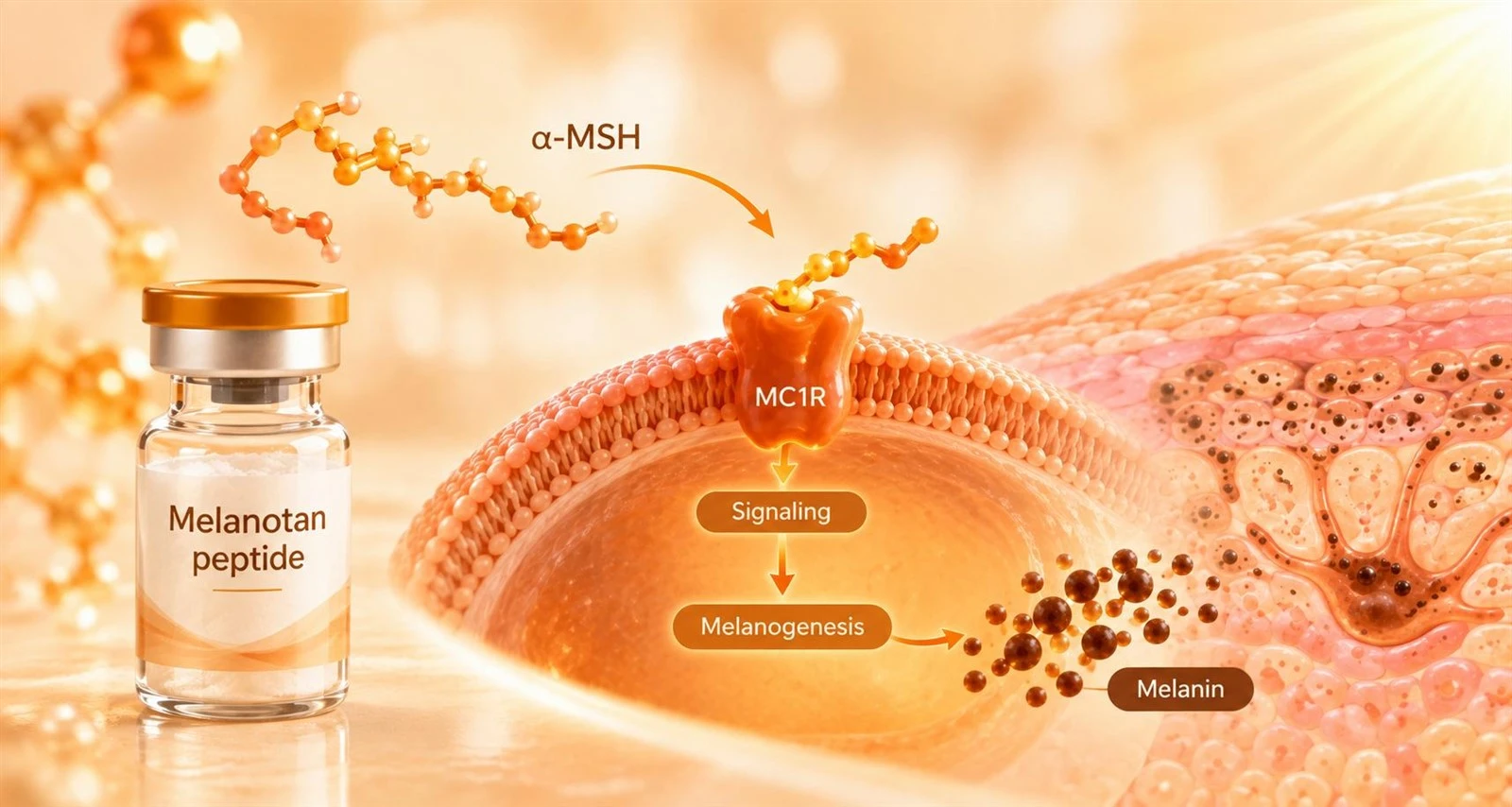
α-MSH is a key signaling molecule within the melanocortin system. It binds to the MC1R receptor on the surface of melanocytes, thereby participating in the process of melanogenesis (melanin production).
Simply put, this pathway can be visualized as follows:
α-MSH → MC1R → Melanogenesis → Melanin
Melanotan-class peptides were synthetically designed based on the key structural features and receptor activity of α-MSH.
Early research revealed that certain α-MSH analogs exhibited stronger or more prolonged melanotropic activity than natural α-MSH; consequently, they became valuable tools for studying melanogenesis and melanocortin receptor signaling.
This is also the origin of the "Melano" prefix in the name Melanotan-it reflects the compound's direct link to research on melanin.
2. How do Melanotan peptides work?
A key focus of Melanotan research is melanocortin receptor signaling.
Melanocytes in the skin produce melanin, and the MC1R receptor plays a crucial role in this process.
When α-MSH or a related melanocortin agonist binds to MC1R, it triggers a cascade of intracellular signals that ultimately influence melanin synthesis.
One significant outcome is the promotion of eumelanin production.
Eumelanin is a major type of melanin that determines skin and hair color; it is also frequently discussed in studies regarding skin pigmentation and responses to ultraviolet (UV) radiation.
Therefore, from a mechanistic perspective, Melanotan peptides can be understood as:
Synthetic peptides developed based on the melanocortin receptor pathway.
However, the actual process of melanogenesis is not controlled by a single on/off switch. Genetic variations in MC1R, cellular states, and other signaling factors can all influence the final melanin production response.
3. Are Melanotan I and Melanotan II the same?
No.
Although their names are very similar and both belong to the research framework associated with α-MSH, they differ in their structural and pharmacological properties.
Melanotan I
Melanotan I is typically associated with NDP-MSH, or [Nle⁴,D-Phe⁷]-α-MSH.
It is a synthetic analogue of α-MSH, with research primarily focused on melanogenesis and skin pigmentation. Clinical studies have observed that it increases melanin density in human skin.
Melanotan II
Melanotan II (MT-II) is a cyclic synthetic peptide featuring structural modifications to the relevant regions of α-MSH.
Early human studies demonstrated that MT-II possesses significant melanotropic activity and leads to increased skin pigmentation. However, these studies also reported side effects such as nausea, drowsiness, fatigue, and yawning.
Therefore, when discussing Melanotan-particularly regarding specific structures, pharmacological activities, or research findings-it is essential to clarify whether the substance in question is Melanotan I or Melanotan II.
4.What is the relationship between Melanotan and melanin?
This is one of the core areas of research regarding Melanotan.
Human skin color is closely linked to the melanin produced by melanocytes, and α-MSH-MC1R signaling is a key mechanism regulating melanogenesis.
In relevant experiments, Melanotan-class molecules have been shown to activate the melanocortin receptor pathway and influence melanin synthesis.
Taking research on Melanotan I as an example, a study involving 77 participants observed a significant increase in skin melanin density in the treatment group following the administration of NDP-MSH. The study also examined how different MC1R gene variants influenced this response.
This highlights a crucial point:
Melanotan does not simply "add color" to the skin; rather, it interacts with the body's own melanogenesis signaling pathways.
Consequently, biological variations in MC1R itself are also a focus of research.
5. Why are researchers interested in Melanotan?
The research value of Melanotan extends well beyond the concept of "tanning."
From the perspective of biomedical research, it actually involves a broader system: melanocortin signaling.
Melanocortin receptors are distributed across various tissues and participate in a wide range of physiological processes. Consequently, studying α-MSH analogs can help researchers gain further insight into:
MC1R receptor function;
Melanin production;
Melanogenesis signaling;
α-MSH-related biology;
Skin responses to ultraviolet (UV) stimulation;
The effects of different MC1R gene variants.
For this reason, Melanotan is not merely a subject of study centered on "tanning."
The underlying receptors and signaling pathways themselves constitute a biological system worthy of investigation.
6.Melanotan Peptides: FAQ
6.1How are Melanotan peptides related to α-MSH?
Melanotan peptides are synthetic analogs designed based on the structure and receptor activity of α-MSH, with research focusing largely on their effects on melanocortin receptors.
6.2What is the difference between Melanotan I and Melanotan II?
While both are α-MSH-related peptides, their structures differ. Melanotan II is a cyclic peptide that exhibits potent melanotropic activity, whereas Melanotan I typically refers to NDP-MSH.
6.3Why are Melanotan peptides associated with skin color?
This is primarily because melanocortin signaling-specifically the activation of MC1R-is linked to melanogenesis in melanocytes.
6.4Is Melanotan II studied solely for skin pigmentation?
No. Because melanocortin receptors are involved in various physiological processes, Melanotan II has also been studied for other physiological effects, including early research into erectile responses in humans.
6.5Are Melanotan peptides ordinary cosmetic products?
They should not be viewed simply in that light. These compounds primarily belong to the fields of pharmacological and biomedical research; the regulatory status and legal uses of specific products depend on the region and the specific product in question.
7. Conclusion
Interest in Melanotan peptides initially stemmed from a relatively straightforward scientific question:
Could human melanogenesis be studied by mimicking α-MSH-related signaling?
As research progressed, the answer proved far more complex than initially anticipated.
While both Melanotan I and Melanotan II are linked to α-MSH, melanocortin receptors, and melanogenesis, they are not identical compounds. Melanotan II, in particular, has garnered significant attention in melanocortin research due to its cyclic structure and potent melanotropic activity.
From an educational perspective, the key concepts for understanding Melanotan are actually quite simple:
α-MSH → MC1R → Melanogenesis → Melanin
However, the aspects truly worthy of continued attention lie in the broader implications of this signaling system-such as genetic variations in receptors, the regulation of skin pigmentation, the mechanisms of melanogenesis, and the role of the melanocortin pathway in other physiological processes.
Research in this field is ongoing. While new clinical studies are exploring potential applications, it is also crucial to carefully consider safety signals identified in existing research.
Therefore, rather than simply labeling Melanotan a "tanning peptide," it is better understood within a broader biomedical context: it represents a class of synthetic peptides developed around melanocortin signaling, with melanogenesis serving as merely the most visible-and earliest-area of study.