

If you have recently been exploring peptides or researching growth hormone release, the name CJC-1295 DAC has likely appeared in your search results.
1.What is CJC-1295 DAC?
It is not a "small-molecule compound" in the conventional sense, but rather a specially engineered synthetic peptide. Research into CJC-1295 focuses primarily on growth hormone (GH) release and mechanisms related to growth hormone-releasing hormone (GHRH); the "DAC" (Drug Affinity Complex) in its name is the key feature of the compound.
Unlike peptides with relatively short half-lives, CJC-1295 DAC is designed to bind reversibly to proteins in the blood-such as albumin-thereby slowing its clearance rate and allowing it to remain active in the body for a longer period.
Therefore, if CJC-1295 is viewed as the core structure, DAC can be understood as a crucial design element that enables its "long-acting" capability.
2. What is the mechanism of action of CJC-1295 DAC?
To understand this, one must first grasp the relationship between GHRH and growth hormone.
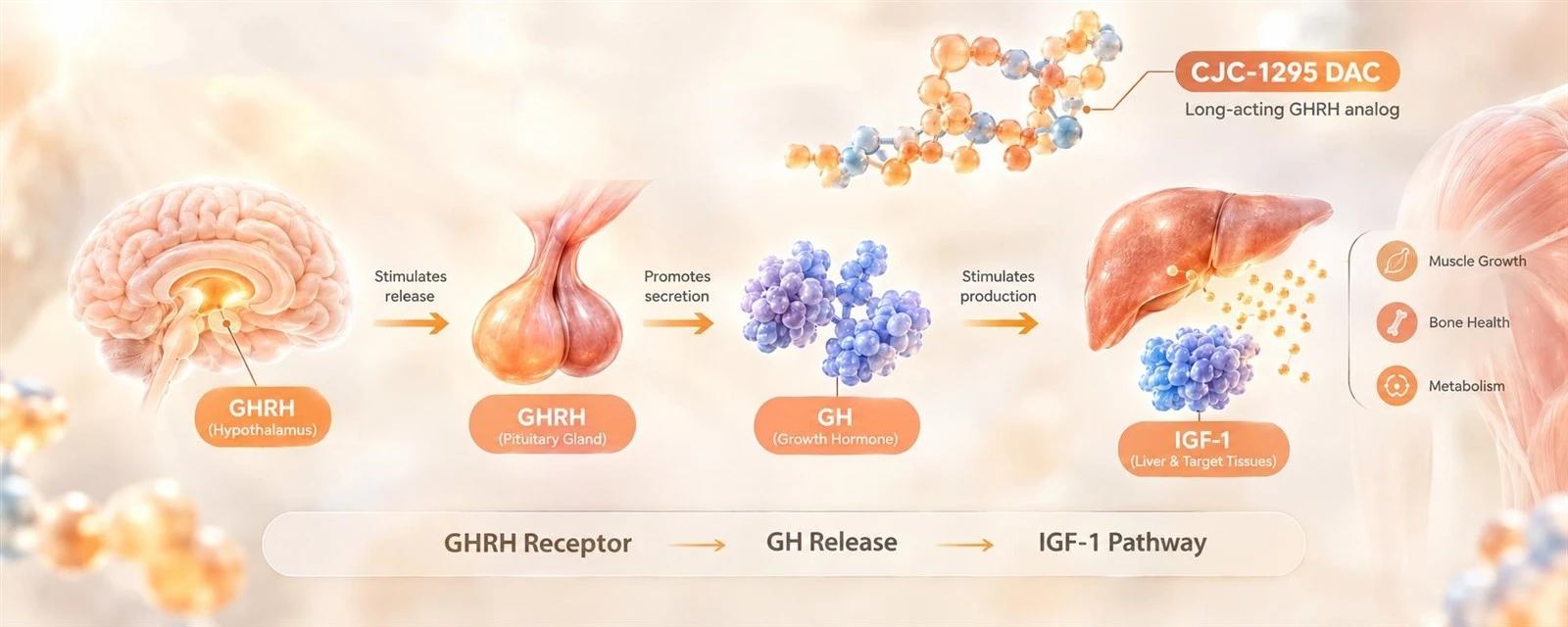
The human hypothalamus produces GHRH. GHRH acts on specific receptors in the anterior pituitary gland, stimulating the release of growth hormone.
Once in the circulatory system, growth hormone further influences other physiological processes-such as signaling pathways involving IGF-1 (Insulin-like Growth Factor 1).
Research into CJC-1295 DAC is based on this physiological regulatory system.
Mechanistically, it promotes growth hormone release primarily by mimicking or enhancing GHRH-related signaling and acting on GHRH receptors in the pituitary gland.
This can be simplified as follows:
CJC-1295 DAC → GHRH receptor signaling → Growth hormone release → GH/IGF-1 pathways
However, the regulation of growth hormone in the human body is not a simple, linear process; it involves factors such as sleep, age, nutritional status, exercise, metabolic state, and the influence of other hormones.
Therefore, when reviewing research on CJC-1295 DAC, one should not simply view it as a product designed to "boost growth hormone." From a scientific perspective, it is more accurately understood as a long-acting peptide tool used to study the GHRH-GH axis.
3. What is the difference between CJC-1295 DAC and CJC-1295?
While "CJC-1295" and "CJC-1295 DAC" are sometimes discussed interchangeably in online resources, there are actually significant differences between them regarding structural design and duration of action.
|
Comparison Item |
CJC-1295 DAC |
CJC-1295 (No DAC) |
|
Structural Features |
Features DAC long-acting design |
Lacks DAC long-acting design |
|
Albumin Binding |
Key design feature |
Typically lacks this feature |
|
Duration of Action |
Relatively long |
Relatively short |
|
Research Focus |
Long-term exposure and GH/IGF-1 related studies |
Short-term GHRH-related studies |
|
Pharmacokinetics |
Favors long-acting profile |
Favors short-acting profile |
Therefore, despite their similar names, the two should not be viewed merely as "different packaging for the same peptide."
4. What is the relationship between CJC-1295 DAC and growth hormone?
CJC-1295 DAC is not itself a growth hormone.
Growth hormone (GH) is a protein hormone secreted by the human pituitary gland, whereas CJC-1295 DAC is a synthetic peptide designed to act on GHRH-related pathways.
To put it simply:
GHRH is a key signal regulating the release of growth hormone;
CJC-1295 DAC is a peptide analog designed to target this signaling system;
GH is the growth hormone released by the pituitary gland;
IGF-1 is a crucial downstream factor associated with the action of GH.
Therefore, research into CJC-1295 DAC essentially involves the human GH/IGF-1 axis and GHRH-related regulatory mechanisms.
5. Pharmacokinetic Characteristics of CJC-1295 DAC
Compared to short-acting GHRH analogs, one of the most notable characteristics of CJC-1295 DAC is its prolonged duration of action "in vivo".
This long-acting profile is primarily attributed to the DAC structure and its binding to albumin.
Albumin is present in high concentrations in human plasma and possesses a long circulating half-life. When CJC-1295 DAC binds reversibly to albumin, it effectively creates a "temporary storage state."
This mechanism reduces the rate at which the peptide is rapidly cleared from the body.
This characteristic is of particular interest to researchers, as pharmacokinetic parameters directly influence experimental design, including:
Sampling intervals;
Duration of exposure;
Concentration fluctuations;
Biomarker monitoring;
Physiological responses at various time points.
However, specific values for half-life, exposure levels, and other pharmacokinetic parameters are influenced by factors such as the study subjects, experimental design, dosage, and analytical methods. Therefore, in actual scientific research, the performance of different batches or formulations should not be judged solely based on isolated parameters found online.
6. Research Areas for CJC-1295 DAC
6.1GH Secretion Research
Investigating the effects of CJC-1295 DAC on growth hormone (GH) release and monitoring changes in GH levels over time.
6.2IGF-1 Related Research
Given the close physiological link between GH and IGF-1, research into CJC-1295 DAC often involves monitoring changes in IGF-1 levels.
6.3GHRH Receptor Signaling Research
As a GHRH analog, CJC-1295 DAC serves as a tool for studying GHRH receptors and their downstream signaling pathways.
6.4Long-acting Peptide Development
The albumin-binding strategy embodied by the DAC structure holds significant value for drug development research.
It allows researchers to understand how molecular structural design can be used to extend the duration of a peptide's exposure within the body.
7. How should CJC-1295 DAC be stored?
Peptide research materials generally require storage in accordance with specific product quality standards, the supplier's Certificate of Analysis (COA), and the product instructions.
In general, the following should be strictly avoided:
High-temperature environments;
Prolonged exposure to strong light;
Humid environments;
Repeated freeze-thaw cycles.
Lyophilized (freeze-dried) peptides are typically easier to store than those in solution; however, specific storage temperatures and expiration dates should be determined based on the product's stability data.
For laboratories, establishing a clear sample management system is also crucial. This includes recording details such as:
Batch number → Date of receipt → Storage conditions → Date opened → Date reconstituted → Usage history
Maintaining such records makes it easier to trace the sample source should discrepancies in experimental data arise later.
8. Why is the stability of CJC-1295 DAC a matter of concern?
Peptides are not substances that remain indefinitely stable simply by sitting on a shelf.
Factors such as temperature, pH, oxidative environments, light exposure, and the physical state of the solution (e.g., solid vs. liquid) can all affect peptide stability.
The risk of degradation may increase significantly after reconstitution, as the sample's environment changes.
Therefore, when designing experiments, one must consider the stability of the sample itself in addition to the purity of the CJC-1295 DAC.
For instance, if an experiment requires testing at multiple time points, variables such as the varying degrees of storage, freeze-thaw cycles, or exposure experienced by samples used at different times could influence the experimental results.
This underscores the importance of standardized sample handling and storage conditions in peptide research.
9.Conclusion
CJC-1295 DAC is a GHRH analogue engineered for a prolonged duration of action, with research primarily focused on the GHRH-GH physiological pathway.
The most significant aspect to understand is not merely "CJC-1295," but the "DAC" component.
By binding reversibly to albumin, the DAC moiety extends the compound's duration of action in the body compared to its short-acting counterparts. This design addresses the issue of rapid peptide clearance, a key reason why it has garnered significant attention in peptide development and related research.
For professionals engaged in peptide science, drug development, biomedicine, or laboratory research, a thorough understanding of CJC-1295 DAC's structure, mechanism of action, pharmacokinetics, and stability is far more valuable than simply knowing its name.
It is also important to note that research-grade CJC-1295 DAC cannot be equated with regulatory-approved therapeutic drugs for human use. Decisions regarding human application should be based on regional regulations, clinical evidence, and professional medical advice.