

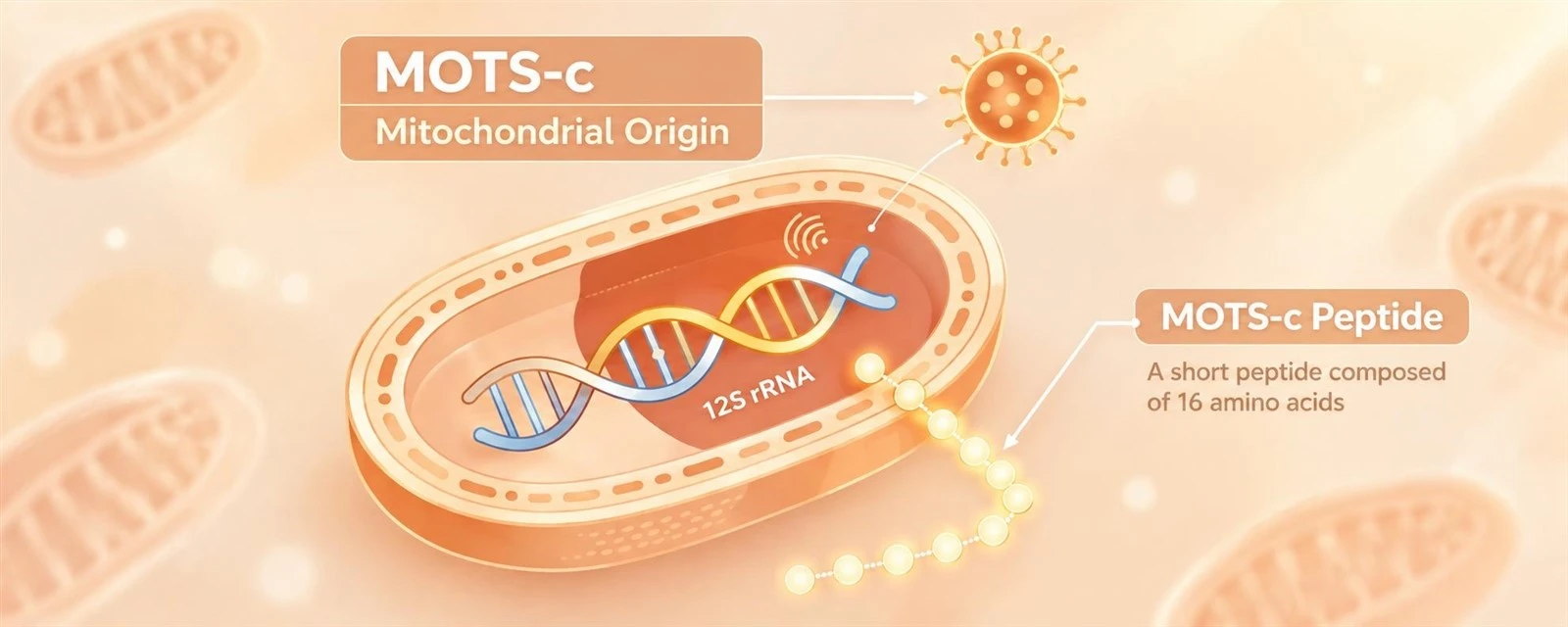
MOTS-c is a relatively short peptide composed of only 16 amino acids.
It originates from a short open reading frame within the "MT-RNR1" (12S rRNA) region of human mitochondrial DNA.
While traditional protein research typically focuses on proteins encoded by nuclear genes, MOTS-c is one of the few identified mitochondrial-derived peptides. Research suggests that the translation of MOTS-c involves transcripts derived from the mitochondrial genome and a cytoplasmic translation process, giving it a unique mechanism of biogenesis.
From a scientific perspective, these small peptides generated from short open reading frames are emerging as a new area of research.
MOTS-c is not the only mitochondrial-derived peptide discovered to date; others, such as Humanin and SHLPs, also fall within this field of study.
Therefore, MOTS-c is not an isolated subject of study but rather part of the broader research into mitochondrial-derived signaling peptides.
1. What makes MOTS-c special?
A unique feature of MOTS-c is its origin: it is derived from mitochondria.
Historically, the understanding of mitochondria focused primarily on their role as the "cellular power plant." However, as research has deepened, scientists have discovered that complex signaling communication exists between mitochondria and the cell nucleus.
MOTS-c represents a significant discovery within this area of research.
It is found not only within the cellular environment but can also be detected in plasma. Studies show that MOTS-c expression varies across different tissues and physiological states, and its levels can be influenced by factors such as exercise, metabolic status, and age.
Consequently, research on MOTS-c has evolved from viewing it merely as a "small mitochondrial peptide" to recognizing its role in mitochondrial-nuclear signaling.
In other words, the value of MOTS-c lies not in its small size, but in its potential function as a signaling molecule mediating communication between mitochondria and other parts of the cell.
2. How does MOTS-c primarily exert its effects?
Based on current research, the mechanism of action of MOTS-c cannot be fully explained by a single, simple pathway.
One mechanism currently attracting significant attention involves its relationship with AMPK (AMP-activated protein kinase).
AMPK can be understood as a crucial intracellular energy-sensing system. When cellular energy status shifts, AMPK helps regulate processes such as glucose utilization, lipid metabolism, and energy balance.
Studies have shown that MOTS-c influences metabolic processes related to the folate cycle and "de novo" purine synthesis, and promotes changes in metabolic intermediates like AICAR, thereby linking to AMPK signaling.
Consequently, many research findings illustrate a relationship along these lines:
MOTS-c → Changes in metabolic pathways → AICAR → AMPK → Regulation of energy metabolism
However, this does not mean that MOTS-c functions solely through AMPK.
Subsequent research has also revealed that under conditions such as metabolic stress, MOTS-c can translocate to the cell nucleus and interact with transcriptional regulatory mechanisms associated with the stress response.
This is precisely what makes research into MOTS-c so fascinating.
3. MOTS-c and Energy Metabolism Research
One of the earliest areas of interest in MOTS-c research was energy metabolism.
Early experimental studies found that MOTS-c may influence how cells utilize glucose and may be associated with AMPK-related signaling. Animal studies also reported changes related to glucose metabolism and insulin sensitivity.
These findings quickly brought MOTS-c into the field of metabolic research.
In particular, researchers have been interested in the relationship between MOTS-c and glucose uptake, glycolysis, and energy utilization in skeletal muscle.
However, it is important to distinguish experimental findings from clinical conclusions.
Much of the current research on MOTS-c has been conducted using cellular and animal models. Results observed in animal studies cannot be directly interpreted as evidence of therapeutic effects in humans. At this stage, MOTS-c is better described as a research molecule with potential metabolic regulatory activity that warrants further investigation.
4. MOTS-c and Exercise Research
Physical activity not only increases the body's energy demands but also imposes a degree of metabolic stress on muscle cells. Researchers have observed a link between exercise and changes in MOTS-c levels.
Studies using animal models and cell cultures have found that MOTS-c expression levels increase following exercise. Consequently, MOTS-c has become a subject of interest in the study of exercise adaptation and metabolic regulation.
Early animal studies have also explored the relationships between MOTS-c, exercise capacity, and metabolic status.
This does not imply that MOTS-c has been proven to be a substitute for exercise, nor does it indicate that it definitively enhances exercise capacity in humans. Based on current evidence, it is more appropriate to view MOTS-c as a potential research tool for investigating exercise adaptation and metabolic signaling.
5. MOTS-c and Aging Research
Another important area of MOTS-c research in recent years is aging.
As people age, mitochondrial function, energy metabolism, and cellular stress responses can all change. This has naturally made mitochondrial-derived peptides an increasingly interesting subject in aging research.
Studies have observed that MOTS-c levels may be associated with age, while animal research has explored potential links between MOTS-c, metabolic health, physical activity, and age-related changes.
This is also why MOTS-c is frequently discussed alongside research topics such as:
MOTS-c + aging + metabolism + mitochondrial function
At the same time, this field is still developing.
The potential relationship between MOTS-c and healthy aging is certainly interesting, but considerably more research is needed before its role can be translated into established clinical applications in humans.
6. Why are researchers interested in MOTS-c?
The research value of MOTS-c can be summarized by three key terms:
Mitochondria, metabolism, and signaling.
In the past, mitochondria were primarily viewed as organelles responsible for ATP production. However, the discovery of mitochondrial-derived peptides like MOTS-c has prompted researchers to reconsider a fundamental question:
Can mitochondria actively "transmit information" to other parts of the cell via small peptides?
The discovery of MOTS-c provides a prime example for studying this question.
It is linked to metabolism, participates in stress-related signaling, and may even influence gene expression at the nuclear level.
For peptide research and development, these characteristics-spanning the mitochondrial, cytoplasmic, and nuclear compartments-make it a highly compelling subject of study.
7. How does the MOTS-c peptide differ from conventional peptides?
A key distinction between MOTS-c and common research peptides is its natural origin: the mitochondrial genome.
While many conventional proteins and peptides are primarily encoded by nuclear DNA, MOTS-c originates from a short open reading frame within the mitochondrial 12S rRNA region.
This is one reason why research into mitochondrially derived peptides has gained significant attention in recent years.
From a scientific research perspective, MOTS-c enables researchers to further explore:
how mitochondria generate signaling molecules;
whether small open reading frames possess additional functions;
how mitochondria influence the cell nucleus;
how metabolic status affects gene expression;
and how small peptides participate in cellular stress adaptation.
These topics offer ample opportunities for further in-depth study.
8. What should be considered regarding research-grade MOTS-c samples?
For laboratory research, the quality of the MOTS-c product is a critical factor.
Since peptides are susceptible to factors such as storage conditions, solution parameters, and repeated freeze-thaw cycles, researchers should pay close attention to the following information when selecting and using research-grade MOTS-c:
8.1Purity
HPLC is a common method for analyzing peptide purity and determining the proportion of the target peptide within the sample.
8.2Molecular Weight
Mass spectrometry results can be used to verify whether the sample's theoretical molecular weight aligns with the experimentally measured value.
8.3COA
The Certificate of Analysis (COA) for a specific batch provides researchers with detailed testing information for that lot.
8.4Batch-to-Batch Consistency
Consistency between batches is crucial for long-term experiments, as variations in samples can affect experimental reproducibility.
8.5torage Conditions
Samples should be stored according to the product instructions and stability data provided by the supplier; storage conditions applicable to other peptides should not be indiscriminately applied.
9.Conclusion
Judging solely by its name, MOTS-c might appear to be nothing more than a small peptide; however, it holds significant research value.
MOTS-c is a mitochondrial-derived peptide composed of 16 amino acids, encoded by a short open reading frame within the mitochondrial 12S rRNA region. Research has linked it to processes such as AMPK signaling, folate metabolism, glucose utilization, cellular stress responses, and mitochondrial-nuclear communication.
Current research on MOTS-c is expanding beyond basic metabolism into fields such as exercise physiology, aging, and age-related diseases.
Naturally, there are still many unanswered questions in this area.
What is the complete mechanism of action of MOTS-c in the human body? Does it function differently across various tissues? What exactly regulates circulating levels of MOTS-c? Further research is required to address these questions.
For this reason, MOTS-c is best viewed as an evolving area of scientific inquiry rather than a fully understood "miracle peptide."
As research into mitochondrial biology and mitochondrial-derived peptides advances, we are likely to see further noteworthy discoveries regarding MOTS-c.