Lying in bed at night, physically exhausted yet with a mind that won't stop racing-only to wake up feeling as though you haven't rested at all-is a common phenomenon among modern people and a significant topic in the realm of health and wellness.
Against this backdrop, a neuropeptide known as DSIP (Delta Sleep-Inducing Peptide) has recently attracted attention in the fields of peptide research and science. As the name suggests, the primary focus of DSIP research is sleep.
Current publicly available research indicates that DSIP studies primarily center on sleep, stress responses, and nervous system regulation. However, further rigorous research and clinical evidence are required to fully confirm the extent of its practical efficacy.
1. What exactly is DSIP?
DSIP stands for Delta Sleep-Inducing Peptide.
It is a neuropeptide; early research into it focused primarily on the sleep process. Unlike some peptides targeting the skin, muscles, or metabolism, DSIP has a distinct profile: its research focus lies largely on the central nervous system and sleep states.
Studies have examined the relationships between DSIP and sleep architecture, stress responses, and nervous system activity.
This is a key reason why it has garnered attention in recent years.
Simply put, if the human body is likened to a system requiring continuous operation, sleep acts as a nightly "maintenance" routine. DSIP research focuses precisely on the changes that occur within the nervous system during this process.
2. Why is DSIP attracting attention? It all comes down to "sleep."
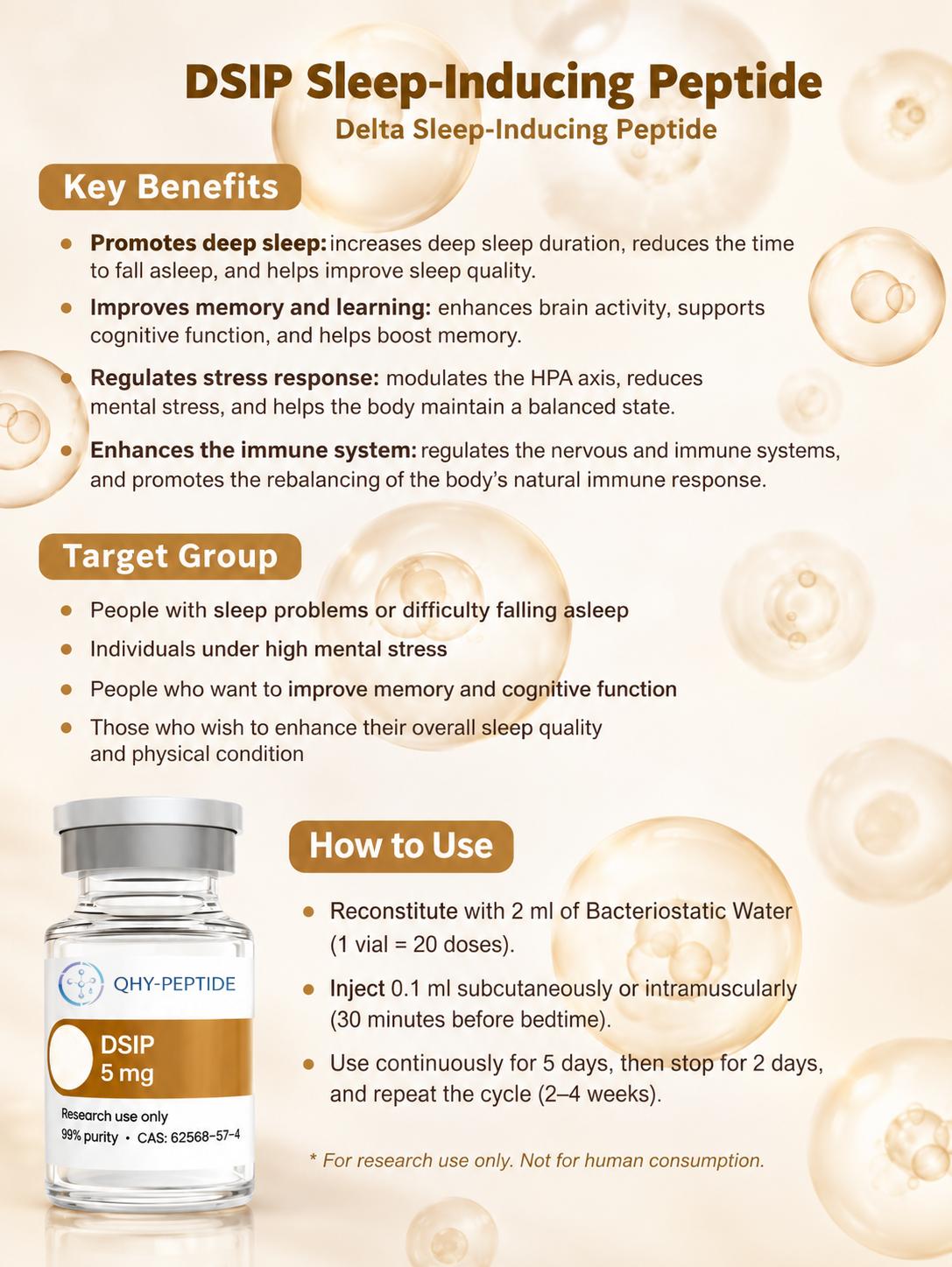
Based on product information, the key areas highlighted regarding DSIP include the following:
2.1. Sleep-related research
Product materials link DSIP to deep sleep and non-rapid eye movement (NREM) sleep duration, emphasizing its potential impact on sleep quality and recovery.
For individuals chronically troubled by difficulty falling asleep or poor sleep quality, the question of "how to truly allow the body to enter a state of rest" is naturally a highly compelling topic.
However, it is important to note that claims in product marketing-such as "promoting deep sleep" or "improving sleep onset"-should not be interpreted as therapeutic effects that have been fully validated in clinical trials. 2. Stress and Mood-Related Aspects
2.2 Beyond sleep, DSIP is also being studied in areas related to the stress response.
The provided materials indicate that research into DSIP involves the hypothalamic-pituitary-adrenal (HPA) axis and stress-related reactions.
This is not difficult to understand.
Sleep and stress are closely linked. When a person is under high stress, they may find it difficult to relax at night; conversely, chronic sleep deprivation can worsen one's mood and mental state the following day.
Therefore, it is not surprising to see DSIP discussed in the context of both sleep and stress regulation.
2.3 Nervous System-Related Research
The materials also mention research directions linking DSIP to nervous system recovery and the immune system.
Research into these effects is ongoing, with some evidence derived from experimental studies; thus, these should be viewed as potential areas of study rather than established clinical benefits.
3. Who Might Be Interested in DSIP?
Based on the target demographics described in product materials, interest in DSIP generally stems from the following needs:
Individuals with poor sleep quality or difficulty falling asleep;
Individuals under chronic, high mental stress;
Individuals prone to tension or anxiety;
Individuals seeking to improve sleep-related recovery.
It is important to note that this "target audience" reflects product positioning rather than an established standard medical treatment for these issues.
In particular, for chronic insomnia, severe anxiety, or other persistent symptoms that impact daily life, one should prioritize seeking professional medical help rather than relying solely on a specific peptide.
4. From "Sleep Peptide" to Peptide Combinations: Shifting Market Focus
An interesting aspect of DSIP is that it does not exist in isolation within the landscape of peptide products.
In certain peptide formulations, DSIP appears alongside ingredients such as Selank, Semax, Epitalon, and Thymosin.
The combination of Selank and DSIP draws particular attention, as both are linked to nervous system research.
Selank is frequently associated with research on stress, mood, and neurotransmitters, whereas DSIP focuses more on sleep and sleep regulation.
Consequently, in product design and research discussions, the two are often assigned distinct functional roles. However, "combination use" does not necessarily guarantee superior results. Further research is required to verify whether genuine synergistic effects exist between the different ingredients.
5. Why is interest in "sleep peptides" growing?
There is a very practical reason behind this trend.
Modern life moves at an increasingly rapid pace. Factors such as work stress, prolonged use of electronic devices, and irregular schedules make getting a "good night's sleep"-something that seems simple-actually quite difficult to achieve.
In the past, people looking to improve their sleep might have first considered adjusting their schedules, exercising, cutting back on caffeine, or creating a more comfortable sleeping environment.
Today, with advancements in neuroscience and peptide research, attention has shifted toward more specialized areas such as neurotransmitters, sleep mechanisms, and nervous system regulation.
It is against this backdrop of research that DSIP has re-emerged in the public eye.
Its true appeal lies not merely in the label of a "sleep product," but in the underlying scientific questions regarding how sleep occurs, how the nervous system regulates it, and how the body enters a state of recovery.
6. Beyond the hype: A need to view research evidence objectively
While the research prospects for DSIP are promising, it cannot currently be described as a "cure-all" sleep peptide.
Current research on DSIP is limited in terms of both the quantity and quality of evidence. More rigorous human clinical studies are needed to determine its actual efficacy, safety profile, suitable user groups, and the risks associated with long-term use. Therefore, consumers should approach online claims regarding "rapid sleep onset," "deep sleep," and "anti-anxiety effects" with a rational mindset.
There is still a long way to go between an ingredient showing potential in the laboratory and its eventual development into a mature, reliable clinical application.
This is a challenge that all research into emerging peptides must face.
7.Conclusion
Sleep is an essential need, and the story of DSIP is just beginning.
From its origins in neuropeptide research to its current emergence into the public eye, DSIP has followed a fascinating developmental path.
It lacks a complex name or a massive molecular structure, yet it naturally commands attention because it is inextricably linked to sleep-a topic relevant to everyone.
For the peptide industry, DSIP represents more than just a specific ingredient; it signifies an expanding field of research-moving from beauty and anti-aging into neuroscience, and progressing from physical repair to the exploration of sleep, stress, and brain function.
Ultimately, of course, the focus must return to the science itself.