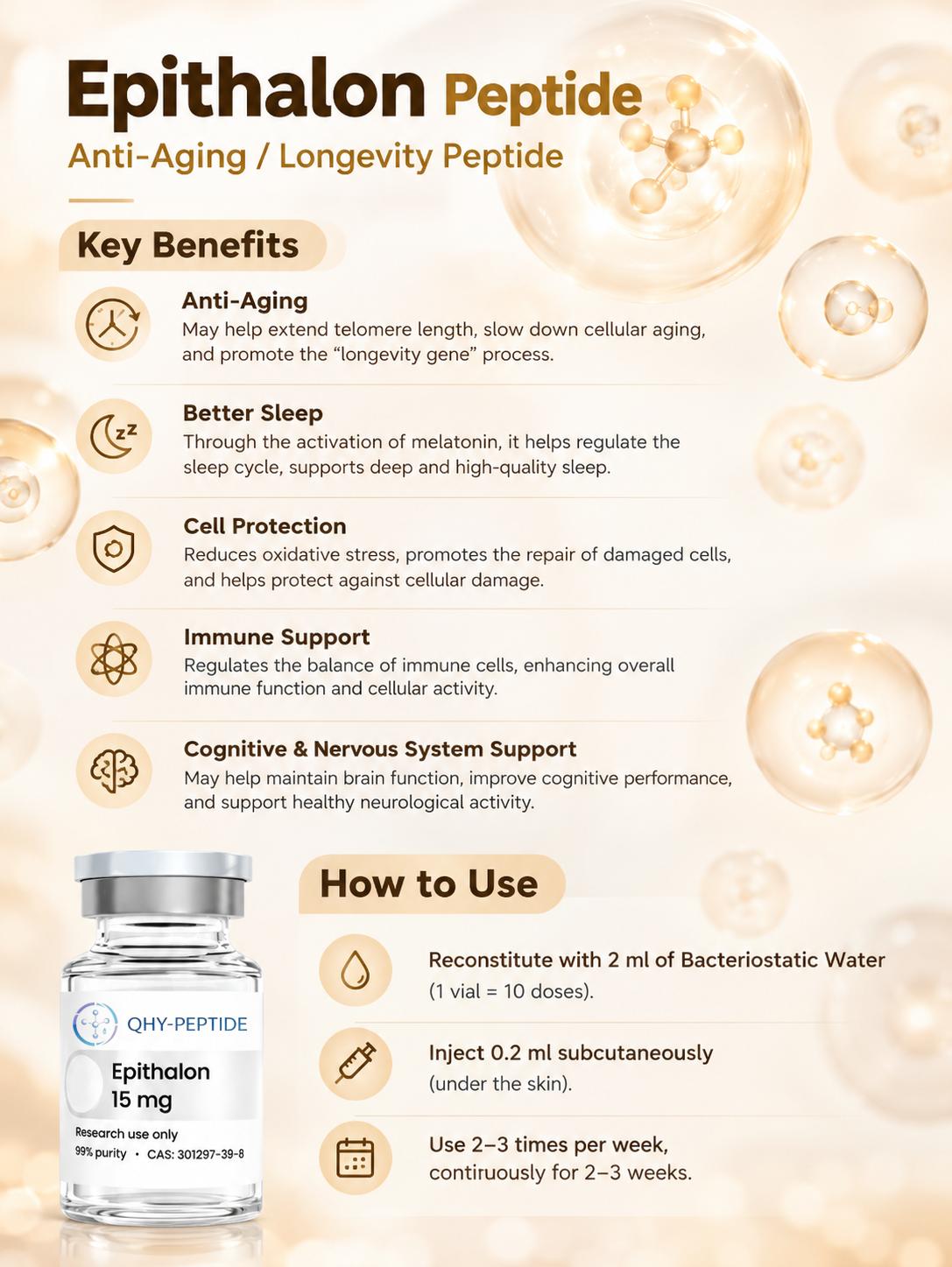
As "anti-aging" moves beyond being merely a buzzword in skincare products, an increasing number of studies are focusing on cellular health, sleep, immunity, and human circadian rhythms. In recent years, a short peptide known as Epithalon has garnered sustained attention within the peptide industry due to its relevance to these areas of research.
Unlike the collagen-based beauty ingredients familiar to many, discussions surrounding Epithalon are not limited to the skin's surface; instead, they center on topics such as cellular aging, telomeres, sleep rhythms, oxidative stress, and immune function.
Epithalon is positioned as a peptide for comprehensive anti-aging research. So, what exactly makes it special? Why has a peptide composed of just a few amino acids sparked so much discussion?
1. What is Epithalon?
Epithalon is a short peptide that has frequently appeared in recent years within the fields of anti-aging and longevity research.
Based on current research trends, a key reason for the interest in Epithalon is its connection to areas such as telomerase activity, cellular aging, and circadian rhythms.
Telomeres can be simply understood as "protective structures" at the ends of chromosomes. As cells divide, telomere length typically shortens, and as they become shorter, the cells gradually age. Consequently, telomeres have long been a major subject of study in aging research.
It is precisely for this reason that discussions about Epithalon often touch upon a question of great interest to many:
Is it possible to modulate certain cellular mechanisms to help cells maintain a healthier state?
This is also why it has attracted attention under the moniker "longevity peptide."
However, from a scientific perspective, "anti-aging research" and "extending human lifespan" are distinct concepts. Epithalon's current research value lies primarily in its potential biological effects; it should not be simplistically viewed as a product proven to extend human lifespan.
2. Epithalon's Key Research Focus: Anti-Aging
Research on Epithalon centers mainly on telomerase activity, telomere length, and the process of cellular aging.
This represents a significant distinction between Epithalon and standard beauty peptides. While typical skincare peptides often focus on surface-level benefits like hydration, firming, and collagen support, research into Epithalon extends the perspective to the cellular level.
Of course, the relationship between telomeres, telomerase, and aging is a complex issue within the life sciences. Even if a substance demonstrates potential effects in experimental studies, one cannot directly conclude that it will enable humans to "reverse aging" or extend their lifespan.
Therefore, a more accurate statement at this stage would be:
Epithalon is a peptide worthy of attention in the study of anti-aging and the mechanisms of cellular aging.
3. Epithalon Research Goes Beyond "Anti-Aging"
It would be an oversimplification to view Epithalon merely as an "anti-aging peptide."
Current research indicates that it spans a wide range of fields, with notable areas of interest including sleep and circadian rhythms, oxidative stress, neuroprotection, and immune-related mechanisms.
This is precisely what makes Epithalon so intriguing.
Human aging is never an isolated process; sleep, metabolism, immunity, the nervous system, and cellular states are all interconnected. Consequently, when a single peptide appears in studies across these diverse fields, it naturally attracts the interest of researchers from various disciplines.
Sleep and Circadian Rhythms
Sleep represents a unique area of focus in Epithalon research.
Existing studies have examined its relationship with the pineal gland and melatonin. A 2025 review summarized previous research on how Epithalon influences melatonin synthesis and circadian rhythms.
Why is anti-aging research linked to sleep?
The reason is actually quite straightforward.
Human circadian rhythms can shift with age, and sleep quality is closely tied to physical recovery, hormone secretion, and the state of the nervous system. Therefore, "anti-aging" and "sleep management" are not entirely separate topics.
4. Antioxidant Effects and Cellular Protection: Moving from "External Age" to "Cellular Status"
Beyond telomeres and sleep, another area of research regarding Epithalon focuses on oxidative stress and cellular protection.
Human cells generate free radicals during normal metabolic processes. Prolonged exposure to high levels of oxidative stress can damage cellular structures; thus, oxidative stress has long been a critical concept in the study of aging and cellular damage.
Product materials link Epithalon to the reduction of free radical-induced cellular damage and the maintenance of cellular viability. This also explains why some peptide products market "antioxidant" and "anti-aging" benefits together.
However, it is important to distinguish between the underlying mechanisms and the actual clinical outcomes. "Antioxidant" is a broad concept; the mere presence of antioxidant mechanisms does not automatically imply an ability to improve every aspect of aging.
For Epithalon, high-quality human study data remains the most important area to watch in the future.
5. The immune aspect also warrants attention
Another area of research regarding Epithalon is immunomodulation.
Some studies have examined its relationship with immune cells, the thymus, and relevant cytokines. A 2025 review summarized earlier research on how Epithalon affects interleukin-2 mRNA and the proliferative activity of mouse thymocytes.
While this topic may be unfamiliar to the average consumer, it is highly intriguing from a scientific research perspective.
As the body ages, the immune system undergoes a series of changes; "immunosenescence" (immune aging) is itself a key component of aging research.
Therefore, it is no coincidence that Epithalon is being studied within the frameworks of aging, immunity, and cellular function.
6. In terms of product design, Epithalon is also being incorporated into peptide combinations
Notably, Epithalon does not appear solely as a standalone product.
Promotional materials for various peptide products often discuss Epithalon alongside other research peptides, frequently featuring it in combinations with compounds such as Selank, Semax, DSIP, TB-500, and BPC-157.
Different peptides have distinct research focuses.
For instance, Selank is frequently studied in the context of stress, mood, and the nervous system; Semax is often associated with cognition and neuroprotection; and DSIP research centers primarily on sleep. In this context, Epithalon can be examined within the broader framework of peptide research.
However, it is crucial to note that simply combining different peptides does not prove the existence of a synergistic effect. There is a fundamental difference between a conceptual combination found in product literature and a clinically validated combination therapy.
7. Rising Popularity, Yet "Scientific Evidence" Remains Key
Epithalon's most significant characteristic-and the primary source of current controversy-lies in the fact that it generates both intense scientific interest and strong market appeal.
Keywords such as "telomeres," "cellular aging," "longevity," "sleep," and "immunity" naturally command attention.
Yet, the more popular a concept becomes, the more important it is to view it objectively.
Much of the current information regarding Epithalon stems from experimental studies, preliminary research, or promotional materials; these cannot be equated with medical benefits that have been fully validated in clinical trials.
Claims involving absolute terms like "extending lifespan," "reversing aging," or "boosting immunity" should be interpreted with particular caution.
For consumers, encountering a new type of peptide calls for a deeper look beyond promotional "benefits"-one should investigate the research origins, clinical evidence, regulatory status, and product credentials.
8. Conclusion: The Answer to Anti-Aging May Lie Beyond the Skin's Surface
From skincare to cellular health, and from beauty to sleep, Epithalon epitomizes the evolution of peptide research toward deeper, more fundamental levels.
Our understanding of aging is shifting as well.
In the past, we gauged age primarily by wrinkles, gray hair, and skin condition; today, scientific research increasingly focuses on cellular status, telomeres, circadian rhythms, and internal physiological changes.
Epithalon has garnered attention precisely because it bridges these trending areas of research.
However, only time and further study will reveal its true potential.
For a peptide that is still under active investigation, the real value lies not in packaging it as a "miraculous longevity code," but in conducting rigorous research to determine-step by step-what it can and cannot do, and under what conditions it is effective.
After all, anti-aging is a complex, systemic endeavor, not a problem that can be solved by a single product. Looking ahead, as research deepens in areas such as cellular senescence, sleep rhythms, and immune regulation, it remains worth the industry's continued attention whether Epithalon can emerge as a significant player in the field of peptide research.