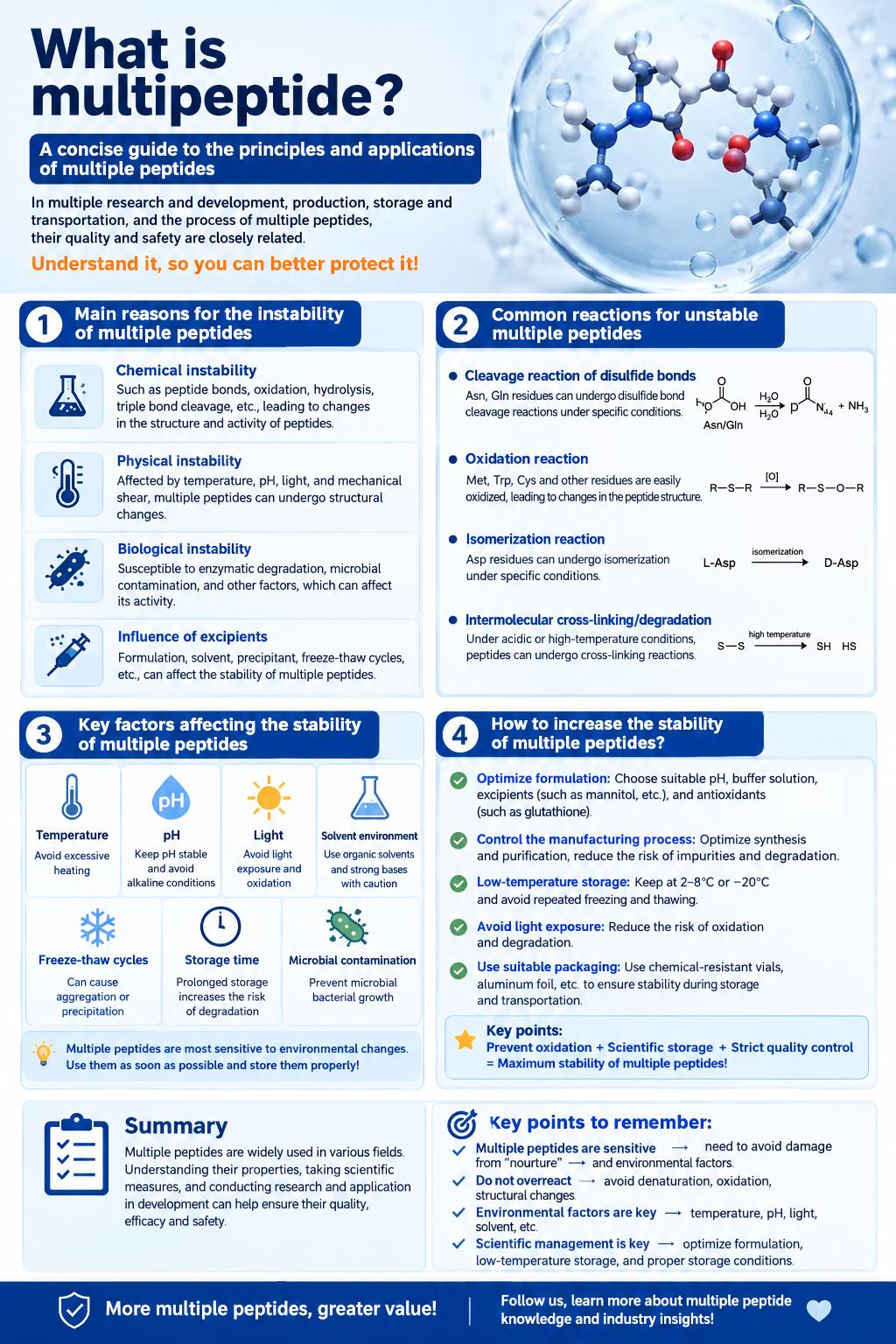
Peptides such as Retatrutide are composed of multiple amino acids linked by peptide bonds. Due to their relatively complex molecular structures and the presence of numerous chemically active groups, peptides are often sensitive to changes in their surrounding environment.
At various stages-including research and development, production, storage, and transportation-peptides can be affected by environmental factors, potentially leading to degradation, oxidation, aggregation, or other structural alterations. Ultimately, these changes can compromise the quality and biological activity of the peptide itself.
Therefore, ensuring peptide stability involves more than simply storing the product in a low-temperature environment. Effective stability management requires a comprehensive approach that considers multiple factors, such as molecular structure, environmental conditions, formulation, manufacturing processes, packaging, storage conditions, and transportation.
In other words, every stage of the process-from R&D through to final storage and transport-can impact a peptide's stability. Only by carefully controlling these factors in light of the specific product's characteristics can the quality and stability of the peptide be effectively maintained.
1. Why Do Peptides Become Unstable So Easily?
Peptide instability is rarely caused by a single factor. In most cases, chemical, physical, biological, and formulation-related factors can interact and affect the stability of the molecule.
1.1 Chemical and Physical Aspects
The peptide bonds and amino acid groups within a peptide molecule are inherently prone to chemical reactions. Influenced by both their intrinsic molecular structure and the external environment, peptides can undergo processes such as hydrolysis, oxidation, isomerization, and disulfide bond rearrangement.
Certain amino acid groups are highly susceptible to oxidation; prolonged exposure to oxygen, light, or oxidizing environments can alter the molecular structure, directly diminishing the peptide's original biological activity.
For peptides containing disulfide bonds, these bonds are crucial for maintaining stability. Under specific conditions, disulfide bonds may break, recombine, or even form undesirable cross-linked structures, thereby disrupting the peptide's native three-dimensional conformation.
In addition to these chemical changes, external physical conditions also affect peptides. Factors such as temperature, pH, light exposure, mechanical agitation, and repeated freeze-thaw cycles can alter a peptide's structure and physical state. High temperatures accelerate degradation reactions, while unsuitable pH levels can trigger chemical reactions; repeated freeze-thaw cycles, in particular, increase the likelihood of peptide aggregation and precipitation.
As molecular structures and properties vary significantly among different peptides, it is essential to evaluate each peptide based on its specific characteristics and develop a tailored storage strategy.
1.2 Biological Instability
Beyond chemical and physical factors, microbial contamination is a concern during peptide production and storage.
If microbial contamination occurs, the microorganisms themselves-and the enzymes they produce-can contribute to peptide degradation, thereby affecting product stability.
Certain peptides, such as Retatrutide, Tirzepatide, and human growth hormone (HGH), may also be susceptible to enzymatic degradation under specific conditions. Once the molecular structure of a peptide changes, its original biological activity may also be affected.
1.3 Formulation and Excipient Factors
Whether a peptide maintains good stability depends not only on the molecule itself but also, to a significant extent, on the formulation and manufacturing process.
Factors such as buffer systems, solvents, excipients, the ionic environment, and the lyophilization process all influence peptide stability.
Even if a peptide is inherently stable, improper formulation or manufacturing processes can still lead to serious stability issues during actual production and storage.
Therefore, the research, development, and production of peptides require a comprehensive approach that considers the peptide molecule itself alongside formulation design, process control, and subsequent storage conditions.
2. What Are the Common Reactions That Cause Peptide Instability?
From a research and manufacturing perspective, several types of chemical and physical changes are commonly considered when evaluating peptide stability.
2.1 Deamidation
Under certain conditions, specific amino acid residues may undergo deamidation, subsequently forming corresponding degradation products or structural variants.
It is important to note that deamidation does not imply complete degradation of the peptide. However, this modification can alter the molecule's charge, structure, and spatial conformation, thereby affecting product quality and biological activity.
2.2 Oxidation
Certain amino acid residues within peptides are particularly susceptible to oxidation; typical examples include methionine (Met), tryptophan (Trp), and cysteine (Cys).
Prolonged exposure to oxygen, light, or other oxidative environments can trigger oxidation reactions, leading to changes in the molecular structure.
Consequently, for peptides prone to oxidation, special care must be taken during research, development, and storage to minimize exposure to oxygen and light.
2.3 Isomerization
Certain amino acid residues, such as aspartic acid (Asp), may undergo isomerization under specific environmental conditions.
While this change does not signify the disappearance or complete degradation of the peptide, it can alter the original molecular structure. If such structural changes affect the molecule's mode of action, the peptide's biological activity may also be impacted.
2.4 Disulfide Bond Cleavage and Rearrangement
For peptides containing disulfide bonds, maintaining the integrity of these bonds is crucial, as they are often closely linked to the peptide's spatial structure and stability.
Exposure to unsuitable reducing or oxidizing environments, or to high temperatures, can cause disulfide bonds to cleave or rearrange. In some instances, undesirable intermolecular cross-linking may occur, leading to further structural changes or even aggregation.
Therefore, appropriate control of environmental conditions is essential during the research, development, production, and storage of disulfide-containing peptides to minimize the occurrence of these structural changes.
3. What Environmental Factors Have the Biggest Impact on Peptide Stability?
When it comes to peptide storage, several environmental factors deserve particular attention.
There are a few particular variables in storage environments that merit special discussion.
3.1 Temperature
Temperature is a critical variable when it comes to peptide stability.
Many types of degradation reactions and physical changes occur faster at higher temperatures. Thus, proper storage temperature should be based on stability studies performed with the peptide/product of interest.
3.2 pH Levels
Peptides vary in how sensitive they are to pH.
Strongly acidic or alkaline environments can accelerate certain degradation reactions. Choosing the proper buffer and maintaining the pH within an appropriate range can be key aspects of stability.
3.3 Light
Light can influence peptides that contain amino acid residues prone to photo-oxidation reactions.
When possible, reducing exposure to light and utilizing containers that offer light protection can help minimize degradation of light-sensitive peptides.
3.4 Solution Exposure
Peptides in solution can be more prone to certain degradation pathways as well as aggregation.
When peptide molecules are dissolved in a solution, they are more exposed to their environment. This can increase the risk of degradation or other unwanted changes. Lyophilization (freeze-drying) is one reason why some peptide products are distributed as dry powders.
3.5 Freeze-Thaw Cycles
Freezing and thawing your peptides is more than just raising/lowering the storage temperature.
Changes in solute concentration, pH shifts, as well as changing interfacial conditions during freeze/thaw cycles can lead to increased peptide aggregation or precipitation. As such, freeze-thaw cycles should be avoided if possible.
3.6 Storage Duration
Peptides will eventually degrade over time, even under ideal storage conditions.
The longer you store a peptide, the greater chance there is for degradation or other structural changes to occur. This is why stability studies and shelf life testing are important.
4. How Can Peptide Stability Be Improved?
Managing peptide stability requires a comprehensive approach that extends beyond the storage phase; planning must begin at the early stages of R&D and encompass the entire supply chain, including production, warehousing, and transportation.
4.1 Optimizing Formulation
The first step is to select a formulation strategy tailored to the specific peptide.
Adjustments are made based on the peptide's inherent properties, focusing on:
- pH and buffer systems
- Excipients
- Solvent systems
- Antioxidant strategies
- Stabilizers
Selecting the right excipients and optimizing the formulation environment effectively minimizes issues such as degradation and aggregation during storage.
4.2 Optimizing Production Processes
Every step of the process-synthesis, purification, concentration, and lyophilization-impacts the stability of the final product.
Strict environmental controls must be maintained throughout production to avoid high temperatures, intense light, and excessive mechanical agitation, thereby reducing peptide degradation and impurity formation.
4.3 Selecting Appropriate Storage Temperatures
Low-temperature storage is a key method for maintaining the stability of many peptides.
However, the specific storage temperature should be determined based on stability test data and product specifications; common requirements range from 2–8°C to even lower temperatures.
It is important to note that lower temperatures are not always better. Some peptides are prone to aggregation or precipitation if subjected to repeated freeze-thaw cycles. Storage conditions must be validated through testing rather than determined by temperature alone.
4.4 Minimizing Exposure to Light and Oxygen
If a peptide is susceptible to oxidation or light sensitivity, exposure to oxygen and intense light must be minimized.
Strategies such as using light-shielding packaging or reducing the oxygen content within the container can help mitigate oxidative degradation.
4.5 Selecting Suitable Packaging Materials
Packaging involves more than simply containing the sample.
Factors such as container material, sealing integrity, and material-peptide compatibility all influence long-term stability.
Depending on the specific peptide, containers with good chemical compatibility and high-barrier materials (such as aluminum foil) can be selected to protect the sample during storage and transportation.
5. The Key to Peptide Stability: It's Not Just About Refrigeration
When it comes to peptide storage, the immediate reaction for many is refrigeration or low-temperature storage.
In reality, however, low-temperature storage is merely one aspect of managing peptide stability-not the whole picture.
A comprehensive strategy for managing peptide stability must account for the product's entire lifecycle, including:
Molecular structure → Formulation design → Manufacturing process → Packaging → Storage → Transportation → Shelf life
Issues arising at any of these stages can compromise the quality and stability of the final product.
To illustrate with a simple example: if oxidation occurs during production, or if suboptimal lyophilization (freeze-drying) conditions alter the molecular structure, subsequent low-temperature storage cannot fully rectify the stability issues already introduced.
Therefore, a more critical approach to managing peptide stability is:
Prioritizing the prevention of degradation rather than attempting to remedy issues after they occur.
From the R&D stage onward, it is essential to fully understand the peptide's structural characteristics and adopt an integrated design approach that considers formulation, manufacturing processes, packaging, and conditions for storage and transportation. This is the most effective way to minimize the risk of future stability issues.
6. Conclusion
The reason peptides can be relatively unstable is closely related to their complex molecular structures and their sensitivity to environmental and chemical conditions.
Factors such as temperature, pH, light exposure, oxygen, freeze-thaw cycles, and microbial contamination can all potentially affect peptide stability.
Common degradation or structural-change pathways include deamidation, oxidation, isomerization, disulfide-bond cleavage or rearrangement, and aggregation. These changes may ultimately affect the peptide's purity, structure, biological activity, and overall product quality.
For this reason, peptide stability should be managed throughout the entire product lifecycle:
Scientific formulation + Controlled manufacturing + Appropriate storage + Suitable packaging + Strict quality control
When these elements work together, the risk of peptide degradation can be significantly reduced, helping maintain the desired quality and biological activity of the peptide throughout its intended storage and use.
In short, peptide stability is not simply about keeping a product cold. It is about understanding the molecule, controlling its environment, and managing every step from formulation to final storage.